Quick answer
What are neural frequencies?
Neural frequencies are the electrical rhythms of the brain, grouped into five bands — delta, theta, alpha, beta and gamma — each tied to a different mental state. Neural frequency programs use precisely calibrated audio to guide the brain toward a target band, a phenomenon supported by decades of EEG research. Carrier frequency matters: the tone carrying the signal affects how efficiently it reaches the auditory cortex.
Key Takeaways
- Your brain operates across five distinct frequency bands (delta, theta, alpha, beta, gamma), each associated with a different mental state
- Neural frequency programs use precisely calibrated audio signals to guide the brain toward a target brainwave state — a phenomenon backed by decades of EEG research
- Carrier frequency matters: the tone your brain processes the signal through affects how efficiently it reaches the auditory cortex
- Neuroplasticity means repeated sessions build lasting structural change — not just a temporary state shift
- Study designs and results vary; a four-week app programme does not prove or promise a durable outcome
If you have ever read about "sound therapy," "Hz programs," or "brainwave entrainment" and found the explanations either too vague to be useful or too technical to follow, this guide is for you. We will explain exactly what neural frequencies are, how the auditory pathway converts sound into brainwave activity, what the peer-reviewed science shows, and why Tihna is built around 4-week programs rather than one-off audio tracks.
Start Here: What Is a Brainwave?
Your brain runs on electricity. Billions of neurons communicate by firing electrochemical signals, and when millions of neurons fire in coordinated patterns, those patterns create oscillations — rhythmic waves of electrical activity — measurable on the scalp using an electroencephalogram (EEG).
These oscillations are your brainwaves. They vary in frequency (how fast they cycle, measured in hertz) and amplitude (how strong they are), and they change dynamically depending on what you are doing, thinking, or experiencing.
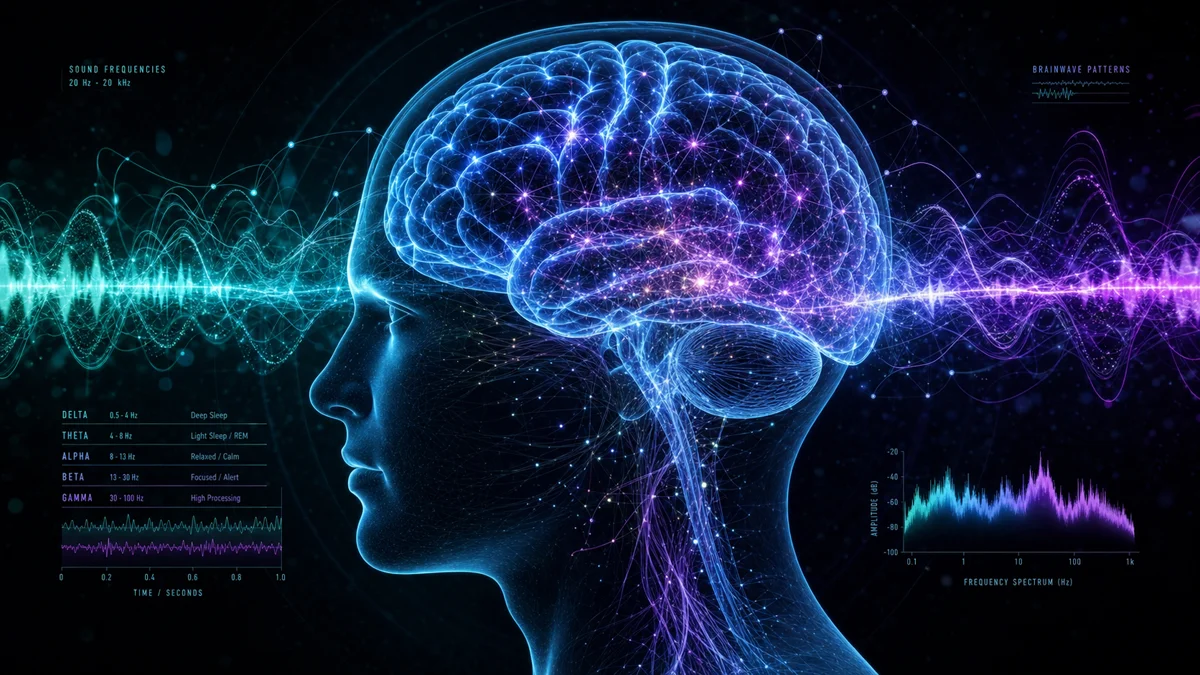
The Five Brainwave Bands
Delta (0.5–4 Hz)
The slowest oscillations. Dominant during deep, dreamless sleep and deep anaesthesia. Critical for physical restoration and memory consolidation during sleep.
Theta (4–8 Hz)
The transition zone between sleep and waking. Active during light sleep, deep meditation, and the hypnagogic state just before sleep onset. A 2025 study in Physiological Reports confirmed that 6 Hz theta stimulation induces cortical entrainment in the precuneus — a key default mode network region involved in self-awareness and meditative states.
Alpha (8–12 Hz)
The resting but awake state. Associated with reduced anxiety, relaxed alertness, and a lowered stress response. A 2026 randomised controlled trial in PLOS ONE found that preoperative frequency program exposure significantly reduced patients' anxiety scores and lowered the anaesthetic dose required for loss of consciousness — a proxy measure for neural arousal state.
Beta (12–30 Hz)
The active, engaged brain. Dominant during conversation, problem-solving, and focused attention. At 15 Hz (sensorimotor rhythm), beta is associated with optimised cortical arousal and attentional performance.
Gamma (30–100 Hz, centred at 40 Hz)
The fastest and most cognitively demanding band. Associated with working memory, executive function, information integration, and peak cognitive performance. A comprehensive 2025 review in the Journal of Central Nervous System Diseases found that 40 Hz stimulation drove improvements in memory, cognitive flexibility, and neural network connectivity across multiple clinical populations.
How the Auditory Pathway Connects Sound to Brain State
The pathway works like this:
- Sound enters the ear and is converted to electrical signals in the cochlea.
- The auditory nerve carries those signals to the brainstem's auditory nuclei.
- The signal reaches the auditory cortex in the temporal lobe, where frequency and pattern are processed.
- Thalamocortical loops — the brain's internal relay system — distribute auditory processing broadly across cortical networks.
When the auditory system receives a rhythmic signal at a specific frequency, a phenomenon called frequency following response can occur: cortical neurons begin to synchronise their firing to match the rhythmic input. This is neural entrainment — the brain's tendency to match the frequency of an external rhythmic stimulus. EEG studies have repeatedly confirmed frequency following response across auditory, visual, and combined modalities.
What Is Frequency Entrainment?
Entrainment describes synchronisation between oscillating systems. Researchers investigate whether rhythmic auditory input can influence measured neural activity, but human findings vary by signal, method and outcome.
Binaural audio presents slightly different tones to each ear and produces a perceived beat at the frequency difference. Calling that difference theta, alpha or gamma describes the audio target; it does not prove that a listener's brain will align to it or enter a promised mental state.
Why Carrier Frequencies Matter
Not all audio delivers frequency programs equally effectively. The carrier frequency — the base tone through which the program is delivered — significantly affects how the auditory cortex processes the signal. Research suggests that mid-range carrier frequencies (roughly 200–500 Hz) produce the strongest frequency following response and the most reliable cortical entrainment. Very low carriers (below 100 Hz) are processed differently by the cochlea and produce less consistent entrainment.
The commonly used range of 200–440 Hz for carrier frequencies is not arbitrary — it maps to the auditory frequencies at which the human brainstem and cortex show the most robust phase-locking to incoming signals. This is why not all "frequency" audio programs are equivalent. Carrier selection, waveform shape, amplitude, and session duration all contribute to how effectively a program entrains the target brain state.
Repeated sessions and the limits of the evidence
Neuroplasticity is a broad property of the nervous system. It should not be used as proof that repeated binaural listening creates a lasting change. Studies of auditory stimulation use different delivery methods and do not establish that Tihna's four-week programmes reorganise the brain.
Claims such as the following require direct evidence and are not promises made by Tihna:
- that repeated sessions strengthen state-specific synaptic connections
- that a listener's thalamocortical networks shift toward a target band
- that a practised state becomes accessible without audio
Tihna's programmes are four weeks long to provide a finite routine and progress record. The structure is not evidence of durable cognitive or psychological improvement.
Peer-Reviewed Sources
- Kosachenko et al. (2024). 6 Hz theta audio protocol reduces sleep-onset latency by 51% — direct demonstration of frequency-following response at clinical scale. Read study → Oxford Academic — Sleep, 2024
- Herrmann et al. (2025). 40 Hz gamma entrainment increases working memory capacity — frequency-following response confirmed via EEG in randomised crossover trial. Read study → PMC / PubMed Central, 2025
- Kim et al. (2026). Preoperative binaural beats reduce remimazolam dosage and enhance safety in anesthesia induction: a randomised controlled trial. A 1 Hz beat (431/432 Hz) for 30 minutes cut the remimazolam dose needed for loss of consciousness from 17.7 to 15.0 mg in 72 patients. The beat was in the delta range, not the alpha range, and EEG spectral analysis found no significant between-group difference. Read study → PLOS ONE, 2026
- Goodin et al. (2024). Neural entrainment via auditory stimulation modulates default mode network and prefrontal-hippocampal connectivity. Read study → PMC / PubMed Central, 2024
Try Tihna — Built on This Science
Four-week programmes for Morning, Focus, Calm and Sleep. Try the five-minute Quick Calm session and review current App Store options.
Download on App Store →