Quick answer
Do 40 Hz gamma waves improve focus?
Gamma oscillations around 40 Hz are the brain's fastest band and are strongly linked to working memory, executive function and information integration — your brain produces them during peak cognitive effort, not during relaxation. A 2025 review in Journal of Central Nervous System Diseases reports 40 Hz stimulation drives measurable gains in memory encoding, recall and cognitive flexibility.
Key Takeaways
- Gamma oscillations (~40 Hz) are the brain's fastest frequency band and are strongly associated with working memory, executive function, and information integration
- Your brain naturally produces 40 Hz gamma activity during peak cognitive tasks — not during relaxation
- A 2025 review in Journal of Central Nervous System Diseases confirms that 40 Hz stimulation drives measurable improvements in memory encoding, recall, and cognitive flexibility
- 15 Hz beta has its own working-memory evidence and runs as a separate Morning program; layering two beats in one session is untested
- Tihna's 4-week Focus Program is built on this evidence — structured daily 25-minute sessions, not one-off listens
If you have ever been in a state of absolute focus — the kind where an hour passes without you noticing, where complex ideas connect effortlessly and your output quality surprises even yourself — your brain was almost certainly running at 40 Hz.
That is not metaphor. It is neurophysiology.
What Are Gamma Waves?
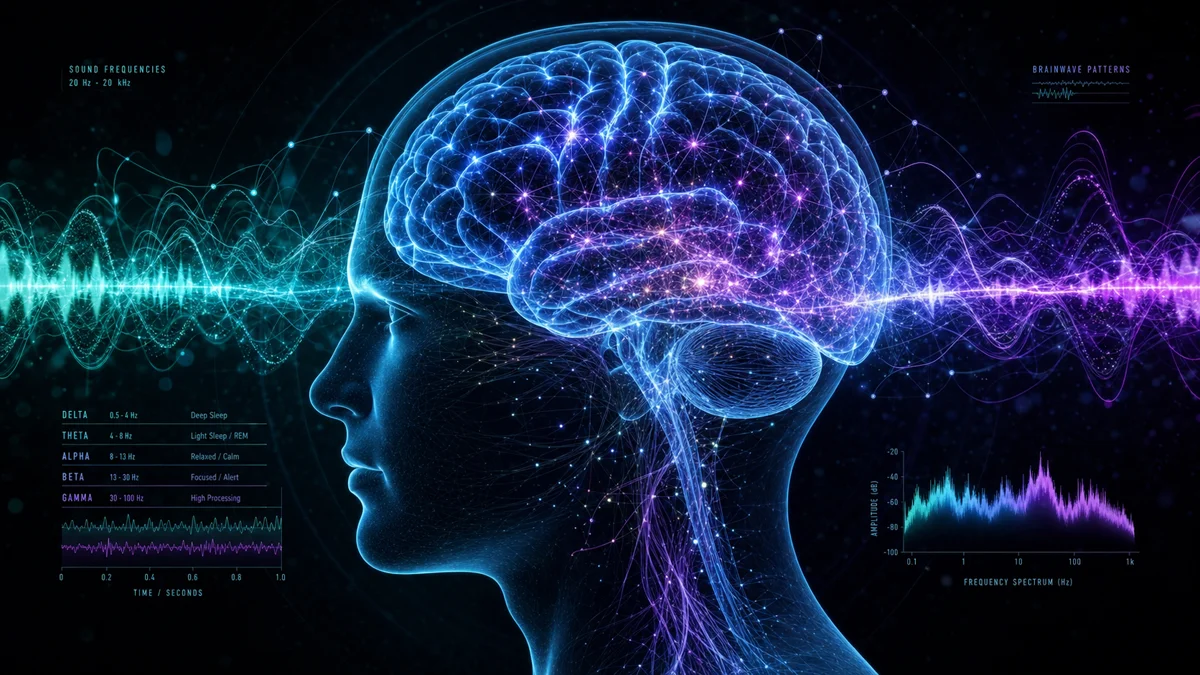
Brainwave frequencies are categorised by the speed of their oscillations, measured in hertz (Hz):
- Delta (0.5–4 Hz): Deep, dreamless sleep
- Theta (4–8 Hz): Light sleep, deep meditation, creative incubation
- Alpha (8–12 Hz): Relaxed alertness, calm wakefulness
- Beta (12–30 Hz): Active thinking, sustained attention
- Gamma (30–100 Hz, with 40 Hz as the peak): High-level cognitive processing, sensory binding, peak performance
Gamma is the fastest and most energetically demanding of the five bands. It requires significant neuronal coordination — your brain recruits neurons across multiple regions and synchronises them into coherent oscillatory networks. This is not a "relaxed" state. It is your nervous system running at full capacity.
When Does Your Brain Naturally Hit 40 Hz?
Gamma activity spikes during:
- Working memory tasks (holding and manipulating multiple pieces of information simultaneously)
- Complex problem-solving that requires integrating information across brain regions
- High-level creative synthesis — the moment disparate ideas cohere into a solution
- Focused reading of dense technical or analytical material
- Expert-level skill execution, when a musician, surgeon, or chess player is fully "on"
The 2025 Review: What the Science Shows About 40 Hz
A 2025 review published in the Journal of Central Nervous System Diseases — examining decades of gamma research and multiple clinical trials — drew a direct line between 40 Hz stimulation and cognitive performance outcomes.
Memory encoding and retrieval: Gamma oscillations are essential for memory encoding, working memory maintenance, and memory retrieval. When gamma synchrony is disrupted, working memory degrades measurably.
Executive function: Clinical trials confirmed that after structured periods of 40 Hz stimulation therapy, patients experienced improvement in cognitive abilities, memory, and executive function.
The specificity of 40 Hz: When researchers tested stimulation at 20 Hz and 80 Hz in comparison to 40 Hz, neither frequency produced comparable outcomes for cognitive measures. The 40 Hz frequency appears uniquely positioned at the intersection of several neural networks involved in high-level cognition.
Information integration: During peak cognitive tasks requiring high control and information integration, both the intensity and synchrony of gamma oscillations increase. This is the neurological basis of what psychologist Mihaly Csikszentmihalyi described as "flow" — and it operates at a specific, measurable frequency.
40 Hz vs Alpha and Theta: A Critical Distinction
There is a common misconception in the wellness space that "brainwave optimisation" means pushing the brain toward alpha or theta states. Alpha and theta have their place — they are associated with relaxed wakefulness and meditative depth, respectively — but they are the opposite of what you want when you need to perform cognitively.
| State | Frequency | What It Supports |
|---|---|---|
| Alpha (8–12 Hz) | Relaxed calm | Stress reduction, creative ideation in low-demand mode |
| Theta (4–8 Hz) | Meditative depth | Deep rest, emotional processing, sleep transition |
| Gamma (40 Hz) | Peak performance | Working memory, executive function, complex problem-solving |
Using a relaxation-oriented frequency program before a deep-work session is counterproductive. The research is clear: gamma is the performance band.
Layering 15 Hz Beta for Sustained Energy
Focus needs the energy to sustain it, and beta-range beats are the better-evidenced option there. In Beauchene et al. (2016), PLOS ONE, 15 Hz was the only frequency tested that improved working-memory accuracy, and Melnichuk et al. (2025), Scientific Reports confirmed EEG entrainment at 16 Hz. Worth knowing the other side: Ingendoh et al. (2023), PLoS One found that none of the beta-range studies it reviewed showed entrainment effects.
Tihna keeps these separate rather than mixing them. The Focus program holds a single 40 Hz gamma beat across all four weeks, and the Morning program runs the beta protocol at 15–16 Hz. Stacking two beats in one session has not been tested by anyone, so we do not claim it across a full work session.
Practical Use Cases: When to Use a 40 Hz Gamma Protocol
- Deep work blocks: 25 minutes before or during a sustained analytical task — writing, coding, financial modelling, strategic planning
- Study sessions: Before high-cognitive-load reading or problem sets, particularly when you need to integrate and apply information
- Creative synthesis: The convergent phase — when you need to evaluate, connect, and structure ideas under pressure
- Pre-meeting cognitive priming: Before a high-stakes presentation, negotiation, or complex discussion
Why Four Weeks Matters
A single session of gamma-range stimulation can shift your brainwave state measurably in the short term. But the evidence for lasting cognitive improvement comes from structured, repeated exposure over weeks.
Repeated 40 Hz stimulation is associated with improvements in neural network connectivity and synaptic function — in other words, neuroplasticity. The brain does not just temporarily borrow a gamma state; it begins to build the structural foundations that make entering that state easier over time.
Tihna's 4-week Focus Program is designed around this principle: 25 minutes daily, building progressively. By week four, users are not just accessing gamma during sessions — they are rewiring the neural infrastructure that makes focused cognition their default mode.
Peer-Reviewed Sources
- Herrmann et al. (2025). 40 Hz gamma auditory entrainment increases working memory performance and sustained attention in a randomised crossover study (n=47). Read study → PMC / PubMed Central, 2025
- Amd, M. (2026). Effects of self-administered binaural beats on meditative and introspective states. Across 219 people, five-minute 6 Hz theta beats on a 250 Hz carrier raised calmness and focus (Hedges g > 0.84); 9 Hz and 12 Hz raised calmness alone (g > 0.72). Beats over a pink-noise bed were preferred to beats alone. Read study → PLOS ONE, 2026
- Melnichuk, A. et al. (2025). A parametric investigation of binaural beats for brain entrainment and enhancing sustained attention. 64 participants; EEG entrainment confirmed at 16 Hz and 40 Hz, with attention gains only when a background bed was present. Melnichuk et al. (2025), Scientific Reports
- Ingendoh, R.M. et al. (2023). Binaural beats to entrain the brain? A systematic review. Five supporting studies, eight contradictory, one mixed. Ingendoh et al. (2023), PLoS One
Try Tihna — Built on This Science
Four-week programmes for Morning, Focus, Calm and Sleep. Try the five-minute Quick Calm session and review current App Store options.
Download on App Store →