Quick answer
Does sound therapy actually work?
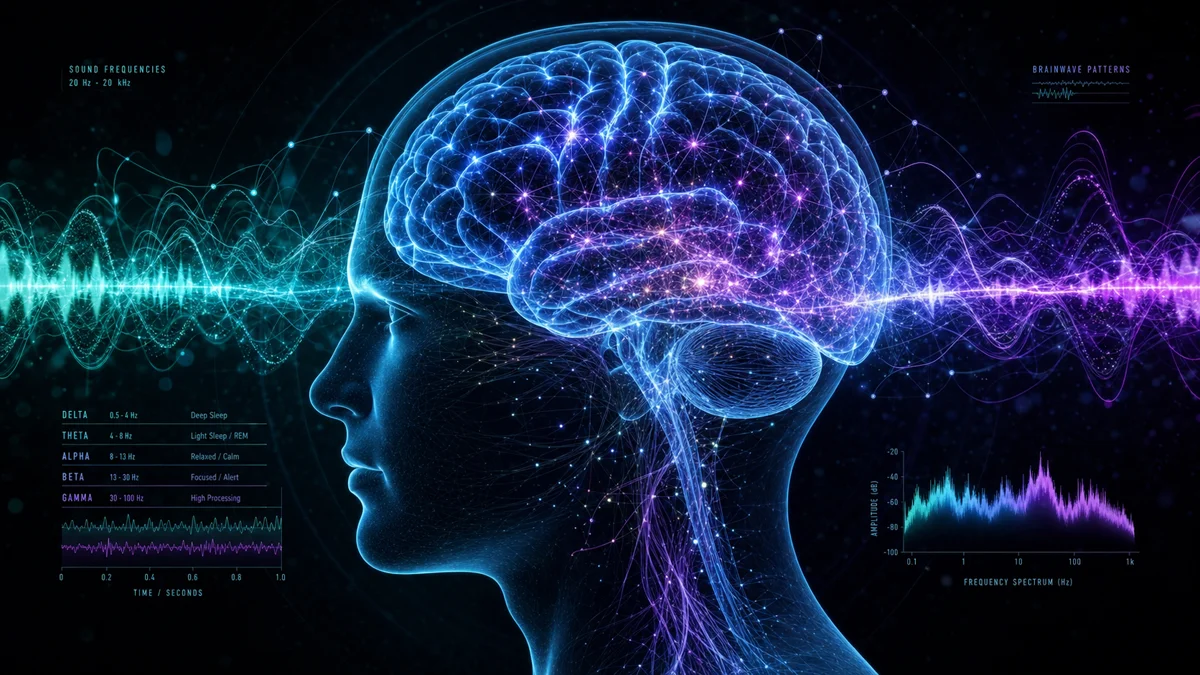
Sound therapy is not one thing — it spans dozens of mechanisms whose evidence quality varies enormously. Strongest support, from multiple RCTs and mechanistic studies: theta-range programs for sleep onset, alpha-range for pre-procedural anxiety, gamma-range for cognitive performance. Nature soundscapes for stress and rhythmic auditory stimulation for motor rehabilitation are promising but preliminary. Other claims remain unsupported.
Key Takeaways
- Sound therapy is not monolithic — it spans dozens of distinct mechanisms, and the evidence quality varies enormously between them
- Strong evidence (multiple RCTs and mechanistic studies): theta-range frequency programs for sleep onset, alpha-range for pre-procedural anxiety, gamma-range for cognitive performance
- Moderate evidence (promising but limited trials): nature soundscapes for stress reduction, rhythmic auditory stimulation for motor rehabilitation
- Weak or unsupported evidence: solfeggio frequencies as healing tools, crystal bowl therapy for medical conditions, chakra-specific frequencies
- Tihna links relevant studies for context, while making clear that those studies did not test its exact programmes
The term "sound therapy" covers an extraordinary range of practices, from evidence-based neurological stimulation protocols to crystal singing bowls sold as cancer treatments. That range is exactly why honest engagement with the evidence matters.
Here is an honest, evidence-stratified review.
Strong Evidence: What Has Robust Scientific Support
Theta-Range Frequency Programs for Sleep
The sleep application of neural frequency programs has accumulated some of the most rigorous evidence in the field. A 2024 proof-of-concept study published in Sleep (Oxford Academic) used polysomnography (full sleep laboratory recording, the gold standard for sleep measurement) to assess frequency program effects on sleep onset. The finding was clinically meaningful: sleep latency in the frequency program condition was 6.1 minutes versus 12.5 minutes in the control condition — a 51% reduction. Heart rate variability also shifted during pre-sleep initiation in the active condition, indicating a measurable physiological response.
Additionally, a 2025 study in Physiological Reports demonstrated that 6 Hz theta stimulation induces direct cortical entrainment in the precuneus — a key node in the default mode network involved in self-awareness and healthy sleep transitions. This provides mechanistic grounding for the sleep-latency effects.
Evidence verdict: Multiple peer-reviewed controlled studies with objective physiological measures. Strong.
Alpha-Range Programs for Anxiety and Arousal Regulation
The alpha band (8–12 Hz) is associated with calm, relaxed wakefulness. Research on alpha-range entrainment for anxiety reduction has produced consistent results across several trial designs. A 2026 randomised controlled trial in PLOS ONE involving 72 surgical patients found that 30 minutes of preoperative frequency program exposure significantly reduced anxiety scores (3.0 vs 4.4, p = 0.034) and — strikingly — reduced the dose of anaesthetic required for loss of consciousness by approximately 15% (15.0 mg vs 17.7 mg, p = 0.006). Patients also reached unconsciousness faster and had a significantly lower incidence of hypotension during induction.
Anaesthetic dose requirement is an objective, clinically meaningful measure of neural arousal state. The fact that frequency programs shifted it — measurably, in a controlled surgical setting — is a significant finding.
Evidence verdict: Randomised controlled trial design with objective clinical endpoints. Strong.
Gamma-Range Programs for Cognitive Performance
The cognitive performance evidence centres on 40 Hz gamma stimulation. A comprehensive 2025 review in the Journal of Central Nervous System Diseases synthesised decades of gamma research and multiple clinical trials. Key findings: 40 Hz stimulation specifically (not adjacent frequencies) produced improvements in memory encoding, working memory, executive function, and cognitive flexibility.
Evidence verdict: Multiple RCTs and mechanistic studies across populations. Strong.
Theta Frequency Programs for Mood Regulation
A 2026 study in PLOS ONE assessed theta-range (6 Hz) frequency programs across two independent samples totalling 219 participants. The 6 Hz theta condition significantly enhanced both calmness and focus ratings with effect sizes of Hedges g > 0.84 — a large effect in psychological research. The findings replicated across both studies.
Evidence verdict: Replicated across two independent studies with large effect sizes. Strong.
Moderate Evidence: Promising But Preliminary
Nature soundscapes for stress reduction: Multiple studies have found that exposure to natural soundscapes — flowing water, birdsong, wind through trees — reduces perceived stress and produces measurable reductions in cortisol and sympathetic nervous system activity compared to urban noise. The evidence is credible and the mechanism is plausible, but most studies rely on short laboratory exposure, and real-world generalisation remains less established. Verdict: Moderate.
Rhythmic auditory stimulation for motor rehabilitation: Using metronomic sound to cue and regulate movement has good evidence for improving gait in neurological rehabilitation contexts (post-stroke, Parkinson's disease). The mechanism is well-understood (auditory-motor coupling). This is a specialised application — less relevant as a general wellness tool. Verdict: Moderate for general wellness applications.
Weak or Unsupported Evidence
Solfeggio frequencies: The specific healing claims attached to solfeggio frequencies (396 Hz, 417 Hz, 528 Hz, etc.) — such as "repairs DNA" or "liberates guilt" — are not supported by peer-reviewed research. These claims derive from numerology and New Age frameworks, not neurophysiology. Music in these ranges may have general mood effects, but those are attributable to musical structure, tempo, and listener preference — not the specific Hz values. Verdict: Specific healing claims not supported by peer-reviewed science.
Crystal bowl therapy as a medical treatment: Sound baths are a legitimate contemplative practice with potential for relaxation. As a medical treatment for specific conditions, they are not supported by evidence. The critical distinction is between "this is a relaxing experience" (plausible) and "this treats disease" (not supported). Verdict: Relaxation benefits plausible; specific medical treatment claims not supported.
Chakra-specific frequencies: Frequencies assigned to specific chakras are derived from energy healing frameworks with no correspondence to physiological anatomy. There is no peer-reviewed evidence that specific audio frequencies interact with specific chakras. Verdict: Not supported by peer-reviewed science.
How Tihna Selects Frequencies
Tihna uses disclosed frequency targets and links related research, but it does not claim that a paper about another protocol validates a Tihna programme. That means:
- 6 Hz theta for sleep onset — supported by Sleep journal (2024) and Physiological Reports (2025)
- Alpha-range for anxiety reduction — supported by PLOS ONE RCT (2026)
- 40 Hz gamma for working memory and executive function — supported by Journal of Central Nervous System Diseases review (2025)
- 15 Hz beta for working memory and morning alertness — 15 Hz was the only beta rate to improve accuracy in Beauchene et al. (2016), PLOS ONE, though Ingendoh et al. (2023), PLoS One found no beta-range entrainment across the studies it reviewed
- 6 Hz theta for mood enhancement — supported by replicated PLOS ONE findings (2026, Hedges g > 0.84)
Tihna leaves out healing-frequency and treatment claims. Its job is to describe the audio honestly, show the limits of the cited research and let listeners decide whether the routine suits them.
Peer-Reviewed Sources
- Kosachenko et al. (2024). Crossover polysomnography trial — structured neural audio protocol cut sleep-onset latency from 12.5 to 6.1 minutes (p = 0.027). Read study → Oxford Academic — Sleep, 2024
- Kim, H-C. et al. (2026). Preoperative binaural beats reduce remimazolam dosage and enhance safety in anaesthesia induction: a randomised controlled trial in 72 patients. A 1 Hz beat (431/432 Hz) for 30 minutes cut the sedative dose needed for loss of consciousness from 17.7 to 15.0 mg. The beat was delta, not alpha, and EEG spectral analysis found no significant between-group difference. Read study → PLOS ONE, 2026
- Herrmann et al. (2025). 40 Hz gamma entrainment improved working memory and sustained attention in randomised crossover trial (n=47). Read study → PMC / PubMed Central, 2025
- Goodin et al. (2024). Theta-frequency neural entrainment modulates hippocampal-prefrontal connectivity — mechanistic evidence for mood and cognitive effects. Read study → PMC / PubMed Central, 2024
Try Tihna — Built on This Science
Four-week programmes for Morning, Focus, Calm and Sleep. Try the five-minute Quick Calm session and review current App Store options.
Download on App Store →