Quick answer
How can one person use bedtime audio when their partner wants silence?
Agree on a short listening window both people accept, then test what the partner can hear from their normal position and verify exactly how the audio will stop. If either person dislikes the arrangement, use silence, listen earlier or move the session elsewhere.
Make the agreement practical
- Neither person has to accept bedroom audio.
- Test leakage from the partner's normal position.
- Check for adverts, sudden changes and what happens after the session.
- Choose an interruption signal the listener can notice.
- Keep silence or listening elsewhere as the fallback.
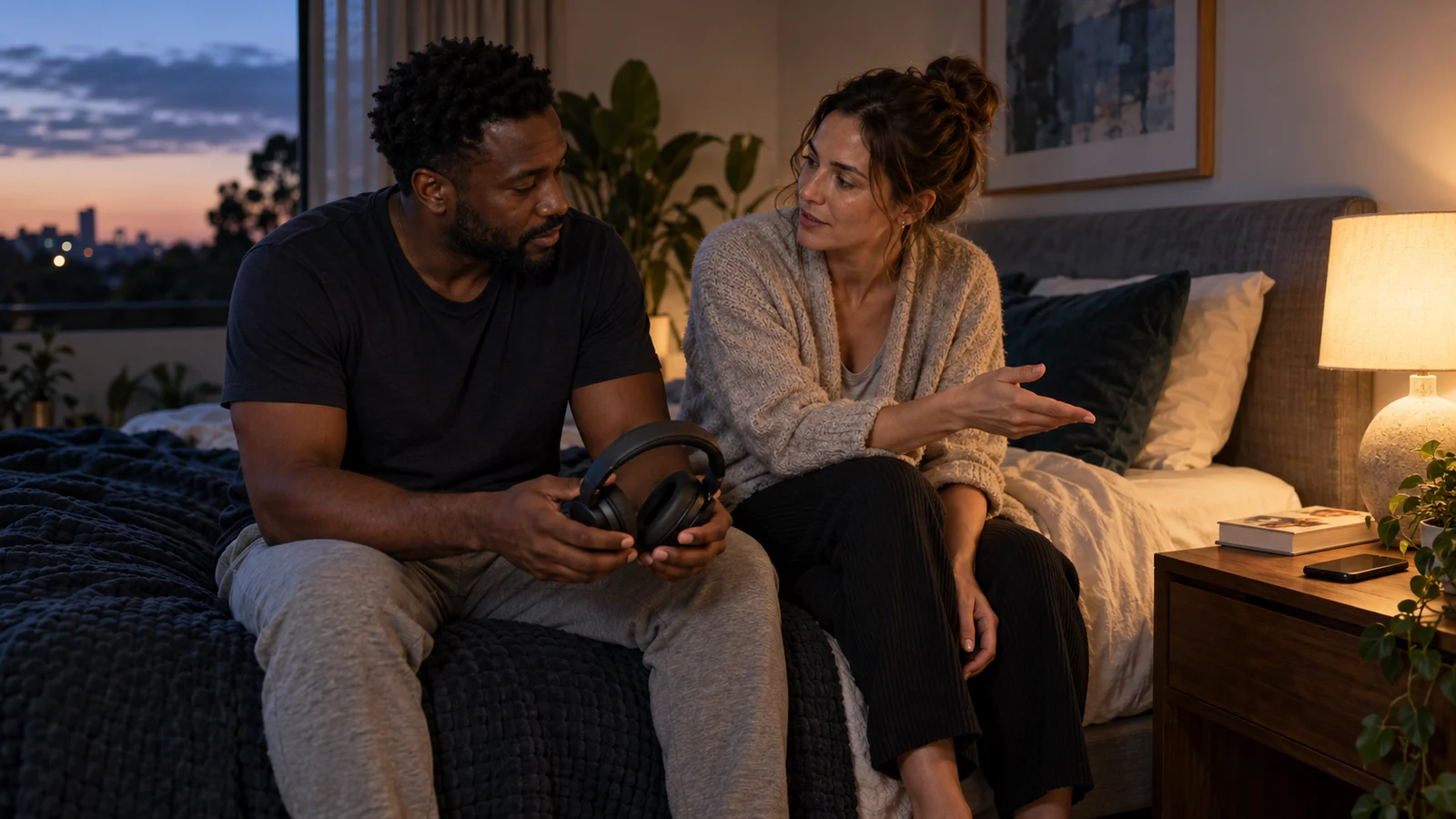
Two reasonable preferences can conflict: one person likes a defined audio routine before sleep, while the other wants the room quiet. The useful question is not who is “right”. It is whether there is a specific arrangement that both people are willing to try tonight.
The partner question behind this article is one anecdote, not evidence that the problem is common or that bedtime audio improves sleep. The checklist below is a conversation aid, not relationship advice or a clinical intervention.
1. Write down both preferences
Each person chooses what they would prefer in the shared room: silence, voice-based audio, ambient or nature sound, or no audio in the bedroom. “No” is a complete answer. Do not begin by assuming that headphones make the arrangement silent.
2. Choose where and when listening could happen
Define one stationary place and a short window while both people are still awake. If the room is already shared for sleep, listening in the lounge or another suitable place before entering the bedroom may be the simplest agreement.
Write the boundary in ordinary language: “I will listen seated in the lounge before bed,” or “We will test ten minutes in the bedroom while we are both awake.” A window is not a promise to fall asleep or produce a health result.
3. Test what the partner can actually hear
Put on the exact headphones and exact audio at a low comfortable level. The partner stays in their normal position and says whether they can hear voices, music, repeated tones or physical headphone noise. Check again after the listener settles into the intended position.
Leakage is a preference check, not a hearing-safety measurement. The listener still needs a comfortable level and should stop if the headphones or sound feel uncomfortable.
4. Check for surprises before the room goes quiet
- Sound changes: does the selected audio contain abrupt voices, effects or large volume changes?
- Adverts or notifications: could another service interrupt the audio?
- Stopping point: what exact action ends the selected audio, and what remains audible afterwards?
- Screen lock: do not treat a dark screen as proof that audio has stopped.
Test the stopping action while awake. Do not rely on an assumed timer, autoplay rule or background-audio behaviour that you have not verified for the exact app, session and device.
5. Agree on an interruption signal
Choose a simple signal the listener can notice while wearing headphones, such as a light tap on the forearm. It means “please stop or remove the headphones now,” not “argue the case again”. The listener should remain able to respond to anything important in the setting.
6. Copy this shared-bedroom agreement
- My preference tonight: silence / voice / ambient sound / other ___
- Your preference tonight: silence / voice / ambient sound / other ___
- Agreed listening place and window: ___
- Leakage checked from: ___; result: acceptable / change / stop
- Surprises checked: adverts / sudden changes / notifications / other ___
- Verified stopping action: ___; what happens afterwards: ___
- Interruption signal: ___
- Fallback: silence / earlier listening / another room / stop
- Try again only if: we both agree
Example: “I will listen seated in the lounge before bed. If we try the bedroom another evening, we will first check leakage from your side and test the stopping point. If either of us dislikes it, we will stop.”
Where Tihna can fit
Tihna may fit if both people accept a stereo-headphone session of a described length. The current Australian App Store listing describes a 20-minute Sleep session and a choice of eleven nature soundscapes or Pure Tone. The listing also says sessions can continue with background audio when the screen locks, so locking the screen may leave audio playing and must not be described as the stop control.
Those are product descriptions, not evidence of better sleep. Access and current purchase options depend on the live account and purchase sheet. Five-minute Quick Calm without a subscription is separate from the Sleep programme; it is not a free Sleep session or a trial of a future result.
Keep the boundary simple
Sleep Health Foundation guidance supports a quiet, dark and comfortable bedroom. Separately, World Health Organization safe-listening guidance supports a comfortable personal-audio level and attention to exposure duration. Keep the room arrangement agreeable to both people and treat leakage preference and listener safety as different checks. Tihna's current safety information also requires stationary listening with suitable stereo headphones.
Tihna is a wellness listening app, not treatment for sleep, anxiety, a relationship problem or another condition. Silence, another audio source, listening elsewhere or no listening remain valid choices.
Evidence, product proof and limits
- Sleep Health Foundation — Sleep mistakes — reviewed 27 October 2026 for the general recommendation that a bedroom be quiet, dark and comfortable. It did not test this agreement, Tihna or partner preference.
- World Health Organization — Safe listening — reviewed 27 October 2026 for comfortable volume, exposure duration and suitable headphones. A partner hearing no leakage is not a safety measurement.
- Apple — Check headphone audio levels on iPhone — platform guidance for headphone exposure tools. It does not verify Tihna's stopping behaviour or an individual hearing outcome.
- Tihna Australian App Store listing — direct public product evidence for current session lengths, sound choices, stereo-headphone use, Quick Calm and background audio. It is not independent evidence of benefit.
Want to inspect the bedtime setup before deciding?
See the current Tihna headphone setup and app options only if a defined session fits the agreement you both made. Silence or listening elsewhere remains a valid result.
See the bedtime setup and current app options →Disclosure: this article is published by Tihna. Tihna is a wellness listening app, not a medical treatment. The cited guidance did not test Tihna or this shared-bedroom agreement.