Quick answer
How do you keep a morning routine when your start time changes?
Anchor the routine to waking, not to a particular clock time. Protect enough sleep first, then repeat a short sequence—light appropriate to your schedule, water, essentials, one next action and an optional listening cue. A routine cannot make unsafe fatigue disappear.
The flexible five-step anchor
- Check whether you are rested enough to work and travel safely.
- Use light deliberately for the shift you are starting—not automatically.
- Prepare water, food, keys, bag and the first work action.
- Keep the same short order even when the clock time changes.
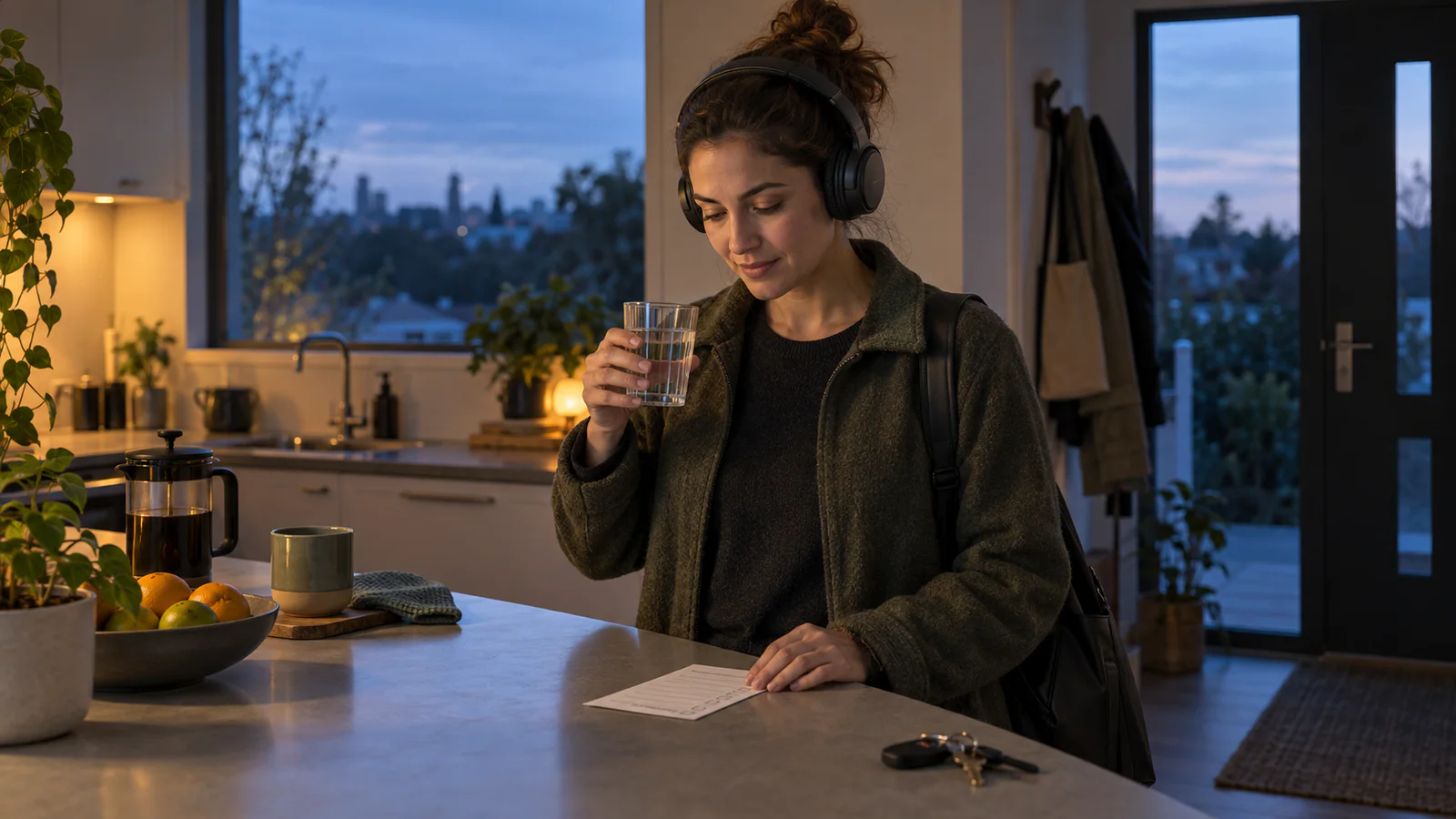
- Use headphones only while stationary and at a comfortable volume.
A fixed 6 am ritual works only when your life reliably starts at 6 am. Cleaners, hospitality workers, carers, healthcare staff, transport workers and people on call may begin before sunrise one day and after lunch the next. The useful goal is not to pretend every start is “morning”. It is to build a small sequence that still makes sense after you wake.
1. Start with the safety question
NIOSH describes work-related fatigue as more than feeling sleepy: it can slow reaction time, reduce attention and short-term memory, and impair judgement. Nonstandard schedules can disrupt or shorten sleep. If you are too drowsy to drive, work around hazards or make safety-critical decisions, a playlist, cold shower or stronger coffee is not a substitute for rest, a safer travel plan or speaking with your employer.
This article is a routine-design guide, not medical or occupational-health advice. Persistent sleep difficulty, loud snoring, unplanned sleep episodes or ongoing excessive sleepiness deserve professional assessment.
2. Anchor the order, not the hour
Write a sequence that begins with “after waking” rather than a clock time. Keep it short enough to work before an early shift and simple enough to repeat before an afternoon start:
- Stand up, open the curtains or set the light appropriate to the shift.
- Drink water and eat if that fits your plan.
- Check keys, bag, transport and the first required item.
- Read one sentence describing the first work action.
- Use an optional listening session only if there is enough safe, stationary time.
Consistency here means repeating the order. It does not mean forcing sleep, waking or caffeine into the same clock time after every roster change.
3. Treat light as a timing signal, not generic motivation
NIOSH guidance says brighter light can increase alertness, and daylight is a strong source for people starting a daytime shift. But light also affects circadian timing. Advice for a 7 am start is not automatically right for somebody finishing a night shift and trying to sleep after sunrise.
If your schedule rotates, use your employer's fatigue guidance or advice from a qualified health professional rather than improvising high-intensity light exposure. The evidence is not a single universal recipe: a 2023 Cochrane review included 11 heterogeneous studies with 2,125 participants and found low- or very-low-certainty evidence for most roster changes.
4. Move decisions to the night—or rest period—before
The changing clock time already creates friction. Reduce the number of fresh decisions after waking. Put the clothes, bag, transport card, food and essential work item in one place. Write the first action before sleeping: “check the opening roster”, “collect the vehicle keys” or “read the overnight handover”.
This is useful even when the routine is interrupted. You are not trying to create a perfect aesthetic morning; you are making the next safe action obvious.
5. If listening helps you begin, give it a clear boundary
Tihna's current Morning programme uses 15-minute stereo-headphone sessions with a choice of eleven nature soundscapes or Pure Tone, followed by progress tracking. That finite format can be used as an optional start cue when you are awake, stationary and have the time.
Tihna has not been tested as a treatment for shift-work fatigue, sleep loss or circadian disruption. It does not guarantee alertness and should never be used while driving, cycling, operating machinery or where headphones would block alarms, traffic or workplace communication. “Morning” is the programme label; it is not an instruction to use it at a biologically inappropriate time.
Keep the volume comfortable. The World Health Organization recommends keeping personal listening devices below about 60% of maximum and, where sound-level monitoring is available, below an average of 80 dB. Lower it further if it feels loud.
Build three versions of the same routine
- Five-minute version: safety check, water, essentials, first action.
- Twenty-minute version: the same anchors plus a 15-minute Tihna Morning session while stationary.
- Post-night-shift version: skip the “wake-up” framing; prioritise safe travel, the sleep environment and your established fatigue plan.
The shorter version is not a failure. A flexible routine survives because it can contract without losing its order.
Evidence and limits
- NIOSH, Fatigue and Work (updated July 2026) — describes nonstandard schedules as a fatigue factor and the effects of fatigue on attention, memory, reaction time and judgement.
- NIOSH, Using light to manage alertness — supports daylight/bright-light guidance for alertness; it is not a personalised circadian treatment plan.
- Hulsegge et al. (2023), Cochrane review of shift-schedule adaptations — 11 studies and 2,125 participants; evidence for most schedule changes was low or very low certainty.
- Booker et al. (2020), sleep hygiene in shift workers — 16-study review finding that standard sleep-hygiene recommendations do not always map cleanly to shift-worker practices.
- World Health Organization, safe listening guidance — reviewed 25 September 2026.
Give your next start a repeatable cue
Explore Tihna's current 15-minute Morning programme, sound choices and purchase options on the App Store.
Explore Tihna on the App Store →Disclosure: this article is published by Tihna. Tihna is a wellness app, not a medical device, fatigue-management system or treatment. The cited evidence did not test the complete Tihna app and does not guarantee an individual alertness, sleep or health outcome.