Quick answer
Why can't you sleep even when you're exhausted?
“Wired but tired” is a mismatch between physical fatigue and brain arousal: cortisol and sustained sympathetic activation keep the brain locked in high-frequency beta past bedtime, so the body is tired while the brain is still alert. White noise, sleep playlists and meditation apps address noise and distraction, but not that underlying frequency mismatch.
Key Takeaways
- "Wired but tired" is a real neurological state — a mismatch between physical fatigue and brain arousal driven by sustained beta-wave dominance
- The root cause is cortisol and chronic sympathetic nervous system activation keeping the brain in high-frequency alert states past bedtime
- White noise, sleep playlists, and meditation apps address symptoms (noise, distraction) but not the underlying frequency mismatch
- The only way to durably resolve wired-but-tired is to retrain the brain's default resting state at the neural frequency level
- Structured 4-week frequency protocols progressively shift the nervous system — one-night solutions don't produce lasting neurological change
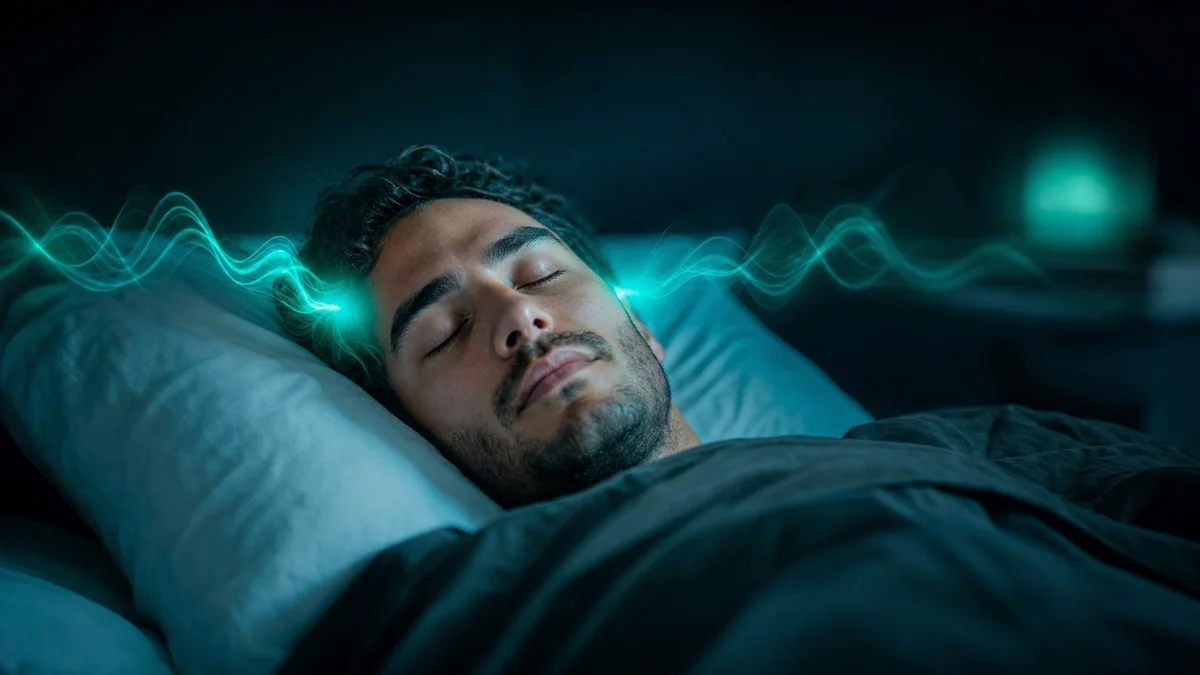
You've had a physically exhausting day. Your body aches. You're yawning through dinner. You're certain you'll be asleep within minutes. Then you lie down, and your brain turns on like a server room at full load.
This is wired-but-tired — one of the most common and least understood sleep problems affecting working adults. It's not standard insomnia. It's not a caffeine problem. And it's not something you can think your way out of, because the thinking is precisely the problem.
The Neurological Mechanism Behind Wired-But-Tired
The brain regulates arousal through its electrical frequency profile. When awake and engaged, it produces predominantly beta waves — high-frequency oscillations (13–30 Hz). Beta dominance is appropriate during the day. Sleep requires a shift from beta through alpha, into theta, and finally into slow delta — a biological process involving reduced cortical firing, falling core temperature, melatonin release, and prefrontal disengagement.
When this transition fails and the brain stays in beta, sleep onset becomes impossible despite physical exhaustion. The body and brain operate on separate schedules.
Cortisol Is the Key Activator
The central driver of wired-but-tired is cortisol — the body's primary stress hormone. Cortisol is designed to be high in the morning and to fall through the day, reaching its lowest point around midnight to support sleep.
Under chronic stress, this curve flattens or inverts. Cortisol stays elevated into the evening, directly suppressing melatonin secretion and maintaining beta-dominant brain activity. The nervous system is, in physiological terms, still in threat-response mode — even when the only "threat" is tomorrow's to-do list. This is not a psychological weakness. It is a measurable endocrine and neurological state.
Humans evolved for short-burst physical stress. The nervous system would spike, resolve, then collapse back into parasympathetic rest. Modern stress has no resolution event — occupational pressure, financial anxiety, and social media produce the same cortisol response as physical danger, with no clear signal that the threat has passed. The result is chronic beta dominance and a disrupted cortisol curve that degrades sleep for months or years.
Why Popular Sleep Products Don't Work for This Problem
Most consumer sleep products are designed to address sleep disruption, not sleep-onset frequency mismatch. There's a meaningful difference.
White Noise and Ambient Sound
White noise and brown noise work by masking environmental sounds that might cause micro-arousals during the night. They're effective for that narrow use case. They contain no frequency information that influences cortical oscillation patterns, and they do nothing to help the brain transition from beta to theta.
If you're lying awake because your brain is running at 18 Hz and needs to be at 6 Hz, a rain sound provides acoustic cover for the situation but doesn't change it.
Sleep Meditation Apps
Apps like Headspace and Calm offer sleep meditations, body scans, and breathing exercises. These are not without value — body scans shift attention from cognition to proprioception, which reduces prefrontal activation. But they require active cognitive engagement: following instructions, maintaining attention, and performing a mental task. For the wired-but-tired brain with elevated cortisol, the cognitive load of "guided relaxation" often keeps the brain more activated, not less.
One-Night Audio Fixes vs Structural Retraining
Even good passive audio — including well-designed neural frequency tracks — produces limited benefit when used randomly. The brain adapts to stimuli it encounters repeatedly in consistent contexts. A neural audio session used sporadically gives the brain nothing to build on.
A 2024 study in Sleep showed that structured neural audio protocols significantly reduced sleep-onset latency under polysomnography conditions (6.1 vs 12.5 minutes, p = 0.027). Crucially, the study used a controlled, consistent protocol — not a random selection from a frequency library.
What Actually Retrains the Wired-But-Tired Brain
The nervous system is plastic — it can be retrained through consistent, structured input over time. Three things are required:
- Consistent frequency input at the target band. Daily sessions using a neural frequency protocol in the theta range (4–8 Hz) give the brain a consistent cortical signal to shift default resting-state activity downward.
- Contextual conditioning. Stimulus-response patterns strengthen when the stimulus occurs in a consistent context. Using a frequency program in the same environment, at the same time, in the same routine builds a conditioned relaxation response.
- Time. Four weeks is not arbitrary. Research on neural habit formation converges on 3–6 weeks as the window in which a pattern shifts from effortful to automatic.
The Progressive Protocol Model
Tihna's Sleep program is structured in four stages, each building on the last:
- Week 1 — introduces the target frequency range, establishing the brain's initial response and the association with the wind-down routine
- Week 2 — extends session duration and slightly varies frequency parameters to prevent habituation
- Week 3 — begins context variation: training the brain to access the same state with shorter cues
- Week 4 — consolidates the resting-state shift, tracking sleep-onset trends across the full program
The goal at the end of four weeks is not audio dependency — it's a nervous system that has genuinely recalibrated its default arousal level.
Wired-but-tired is not solved by trying harder to relax. It's solved by consistently giving the brain a frequency-level signal that the day is over, repeated enough times that the nervous system finally believes it. That's not a quick fix. It's a 4-week project. But at the end of it, you're not managing symptoms with nightly audio — you're sleeping because your brain has learned how again.
Peer-Reviewed Sources
- Kosachenko et al. (2024). Structured 6 Hz theta audio protocol normalises pre-sleep cortical arousal and reduces sleep-onset latency by 51% vs control. Read study → Oxford Academic — Sleep, 2024
- Goodin et al. (2024). Theta-frequency entrainment suppresses default mode network over-activation — the neurological driver of racing thoughts before sleep. Read study → PMC / PubMed Central, 2024
Try Tihna — Built on This Science
Four-week programmes for Morning, Focus, Calm and Sleep. Try the five-minute Quick Calm session and review current App Store options.
Download on App Store →