Quick answer
Which sleep app is best in 2026?
It depends on your listening setup and the experience you want. Compare current platform support, speaker or headphone requirements, session structure, sound options, access terms and whether you prefer guided content, music or a defined routine.
Key Takeaways
- The sleep app market has grown dramatically, but most apps are built around content (meditations, sounds, stories) rather than neurological mechanisms
- Headspace excels at meditation instruction but contains no neural frequency science
- Brain.fm uses frequency-informed audio but lacks structured progression or outcome tracking
- Moongate offers the largest content library but no programmatic structure — it's a catalogue, not a protocol
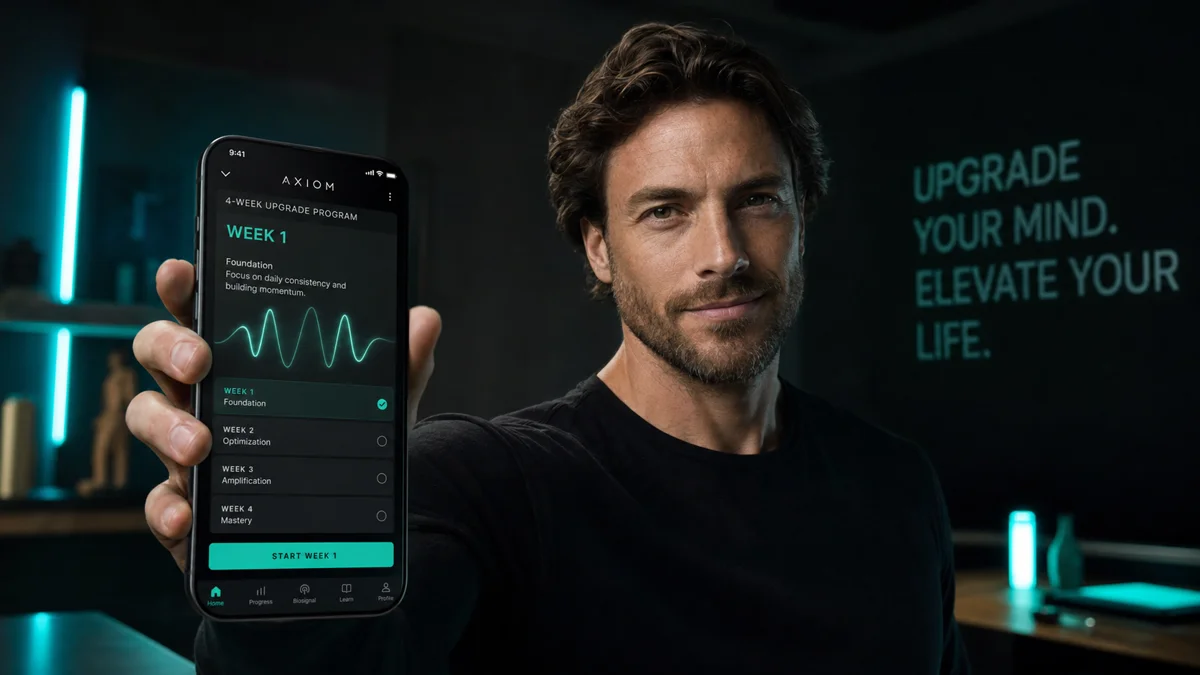
- Tihna offers a structured four-week programme designed for stereo-headphone listening
- Programme structure is a product difference, not proof of better sleep or clinical superiority
The App Store search for "sleep" returns hundreds of results, almost all promising the same thing: fall asleep faster, wake up refreshed. The marketing is nearly identical. The underlying approaches are not.
This is an honest, evidence-referenced assessment of Headspace, Brain.fm, Moongate, and Tihna — the four apps most commonly compared in 2026.
The Science Standard: What Should a Sleep App Actually Do?
Sleep-onset difficulty is primarily a brain-state problem: the brain must transition from high-frequency beta activity to theta and delta. Research in Sleep (Oxford, 2024) confirmed that structured neural audio protocols cut sleep-onset latency from 12.5 to 6.1 minutes in polysomnography-verified conditions. A 2026 PLOS ONE study found 6 Hz theta protocols produced large effect sizes on calmness and focus (Hedges g > 0.84) across 219 participants.
The implication: frequency specificity and structured progression matter. An app delivering calming sounds is a different product — not necessarily worse for certain goals, but categorically different from a structured neural frequency protocol.
Headspace
Approach: Guided meditation, breathing exercises, and sleep stories. Scientifically literate but not frequency-based.
Headspace is the best-known meditation app in the world. Sleep content — "Sleepcasts," wind-down meditations, "Nighttime SOS" — is well-produced and grounded in mindfulness-based stress reduction (MBSR). Headspace has published peer-reviewed research on its own content, which is rare in consumer apps.
What it does well: Best onboarding into mindfulness practice of any app in this category. High-quality sleep stories that function as cognitive distraction for mild sleeplessness. Strong evidence base for meditation as a long-term anxiety and stress intervention.
Where it has limits: Guided audio requires active cognitive engagement — this can delay sleep onset for anyone with elevated cortisol or racing thoughts. No neural frequency protocols; the sleep content makes no attempt to influence cortical oscillations. No structured progression toward a neurological outcome over a defined timeframe.
Best suited for: People building a long-term mindfulness practice with mild-to-moderate sleep difficulty who can follow guided audio at bedtime.
Brain.fm
Approach: AI-generated functional music designed to influence brainwave states across sleep, focus, and relaxation.
Brain.fm is more science-adjacent than Headspace — it explicitly aims to produce brainwave entrainment, and the company has published some research on its focus music. Sleep and relaxation channels use frequency-informed audio design.
What it does well: Frequency-aware audio design — engages the neuroscience of entrainment more explicitly than most competitors. Fully passive: no cognitive engagement required. Infinite sessions that don't end at a fixed track length — more sleep-compatible than time-limited content.
Where it has limits: No defined progression across sessions, no program length, no outcome tracking. A library of audio is not a protocol — browsing a catalogue each night provides no structural reinforcement for neuroplasticity.
Best suited for: People who want frequency-aware ambient audio without structure. Good as a complement to a structured protocol; less effective as a standalone for significant sleep-onset difficulty.
Moongate
Approach: A large content library combining sleep stories, meditations, sound baths, ASMR, frequency sounds, and breathwork — positioned as a "wellness audio destination."
Moongate is notable for its catalogue breadth and its 27-step onboarding flow. The frequency audio section exists but is presented as one content type among many, not as a core product mechanism.
What it does well: Widest content variety in this comparison — genuinely something for every preference. High production quality across categories. ASMR content is particularly strong.
Where it has limits: 27-step onboarding introduces friction before the first session. Library positioning means no programmatic structure — users are curators, not protocol participants. No outcome tracking.
Best suited for: Users who want variety and high-quality audio content without needing a structured sleep-improvement program.
Tihna
Approach: Structured four-week listening programmes with nature soundscapes or Pure Tone mode.
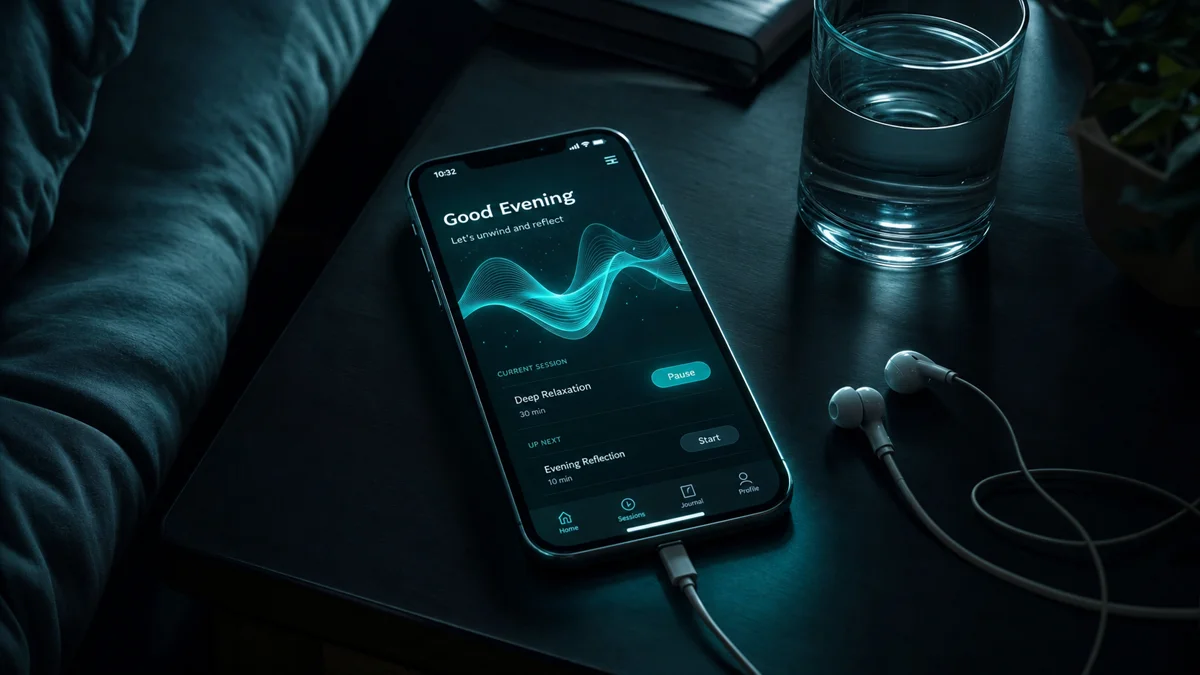
Tihna provides a defined session sequence, progress history and a fixed endpoint. Binaural sessions require stereo headphones.
What it does well: A clear routine rather than an open-ended catalogue, with disclosed frequency targets and a choice of sound backgrounds. Linked research provides context but did not test Tihna.
Where it has limits: Tihna is iOS-only and requires stereo headphones for its binaural presentation. It is a wellness app and does not promise a sleep or clinical outcome.
Best suited for: People who prefer headphones, nature sounds or pure tones and a finite programme rather than an all-night or open-ended library.
Side-by-Side Comparison
| Feature | Headspace | Brain.fm | Moongate | Tihna |
|---|---|---|---|---|
| Core approach | Meditation / guided | Frequency audio library | Multi-category library | Structured Hz programs |
| Neural frequency protocols | No | Partial | Partial | Yes |
| Structured 4-week program | No | No | No | Yes |
| Requires cognitive engagement | Yes | No | Varies | No |
| Research context | Published meditation research | Published company research | Check current official sources | Linked third-party studies did not test Tihna |
| Outcome tracking | Basic | No | No | Yes |
| Onboarding simplicity | Good | Good | Complex (27 steps) | Simple |
| Platform | Check current listing | Check current listing | Check current listing | iOS |
Choose based on the current product experience you prefer. Headspace centres guided meditation, Brain.fm centres functional music, and Tihna centres a structured stereo-headphone routine. For a closer decision between structured sessions, functional music and adaptive soundscapes, read the Tihna, Brain.fm and Endel feature-and-fit comparison. Verify Moongate and every competitor's current features and price on its official listing before deciding.
Peer-Reviewed Sources
- Kosachenko et al. (2024). Dynamic structured neural audio protocol demonstrated 51% reduction in sleep-onset latency in lab-grade polysomnography trial. Read study → Oxford Academic — Sleep, 2024
- Amd, M. (2026). Effects of self-administered binaural beats on meditative and introspective states. Across 219 people, five-minute 6 Hz theta beats on a 250 Hz carrier raised calmness and focus (Hedges g > 0.84); 9 Hz and 12 Hz raised calmness alone (g > 0.72). Beats over a pink-noise bed were preferred to beats alone. Read study → PLOS ONE, 2026
Explore Tihna's structured listening routine
Four-week programmes for Morning, Focus, Calm and Sleep, plus a five-minute Quick Calm session.
Download on App Store →